Ten Strings, and the Four You Never Hear
By Jonathan Raabe
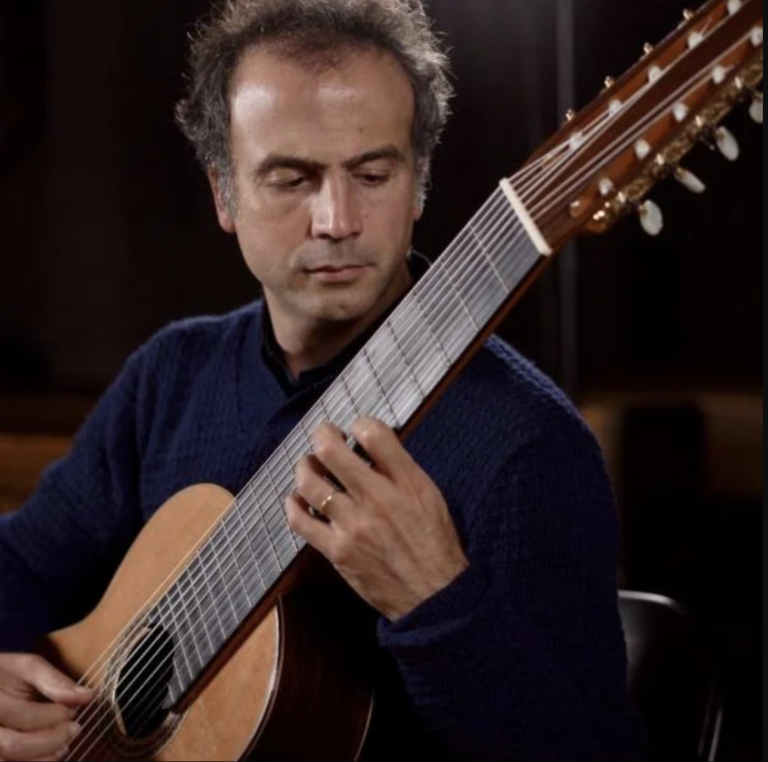
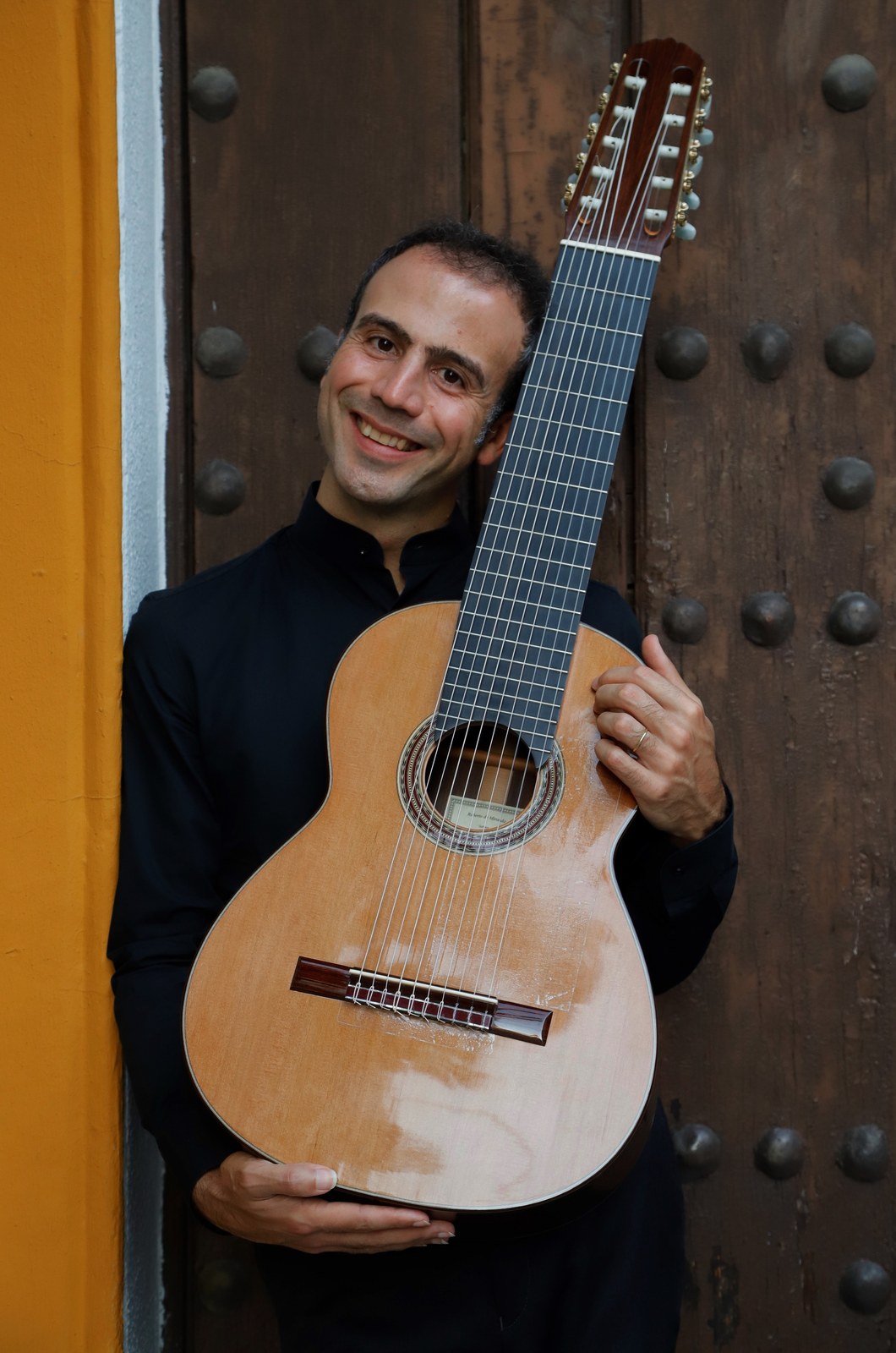
On September 12, in a Boulder living room, Nicolò Spera opened our season with a solo recital on a ten-string guitar. Four of its strings were mostly not played.
That is the point of them.
One thing to get straight first. The October program is not this instrument. Corrado Margutti’s Rivers and Castelnuovo-Tedesco’s Romancero Gitano are both written for the standard six-string classical guitar, and the six-string is what Spera plays on October 9, 10, and 11. The ten-string is the other half of his playing life. It is worth understanding on its own terms, which is what this piece is for.
What the extra four are for
The instrument was conceived in 1963 by the Spanish guitarist Narciso Yepes, working with the luthier José Ramírez III; the first one was finished in March 1964.
Yepes’s reasoning ran like this. Any string instrument has some sympathetic vibration — strike one note and other strings, untouched, ring along with it. On a six-string guitar that happens unevenly. By his account, eight of the twelve notes of the chromatic scale get almost no natural sympathetic resonance at all. Some notes arrive with a halo; others arrive bare.
So he and Ramírez worked out how many extra strings, and at what tuning, would give every note in the chromatic scale that halo. The answer was four, tuned below the standard six at C, B♭, A♭, and G♭.
Here is Spera’s description, which is better than any technical one:
“The main wonder of a 10-string guitar is that because of these extra layers of resonance, there is a shimmer to the sound, kind of like a starry night. The note shines but there is the Milky Way around it and the other strings add these clouds of sparkling sonorities around each note.”
And the mechanism, plainly: “a lot of times the four extra strings on a 10-string make a difference without being played.”
It was not universally admired
Andrés Segovia, who had done more than anyone alive to establish the six-string classical guitar, was unimpressed, and said so publicly: the six the instrument traditionally possesses, he wrote, are quite sufficient.
There is a live dispute in the guitar literature about both halves of Yepes’s claim — whether the acoustic argument holds up as stated, and whether the design was as original as it is usually described. Yepes himself made the second point: the guitar’s ancestors had varying numbers of strings for centuries, and he was returning to something rather than inventing it.
He was right about that. The baroque lute ran to thirteen courses, most of them paired, and a theorbo has fourteen or more, with the longest strings running down an extended neck and a second pegbox, there purely for the bass notes. Spera made the same observation to us, and he plays all three families: six-string, ten-string, and theorbo. Very few people do.
Why a player keeps more than one
The repertoire decides the instrument, not the preference. Music written for ten strings — and music Spera transcribes onto it, including his own arrangements of Bach’s Cello Suites — uses that extra resonance as part of its sound. Music written for six strings does not need it, and is played on six.
Both October works are in the second category. Castelnuovo-Tedesco wrote the Romancero Gitano in 1951 for Andrés Segovia’s instrument, and Margutti wrote Rivers in 2020 for the same one. So the thing to listen for in October is not extra strings. It is a single six-string guitar holding its own as a voice against forty singers — which it does by being written into the texture rather than under it.
Further reading: the ten-string classical guitar of Yepes and the theorbo.
The performances
Friday, October 9, 7:30 pm, Mountain View United Methodist Church, 355 Ponca Place, Boulder. Saturday, October 10, 7:30 pm, St. Paul Center for Music and the Arts, 1600 Grant Street, Denver, and by livestream. Sunday, October 11, 4:00 pm, United Church of Christ, 1500 9th Avenue, Longmont.
Tickets and details: Rivers & Streams. Spera talks about Yepes, his teachers, and the commission in our full interview.