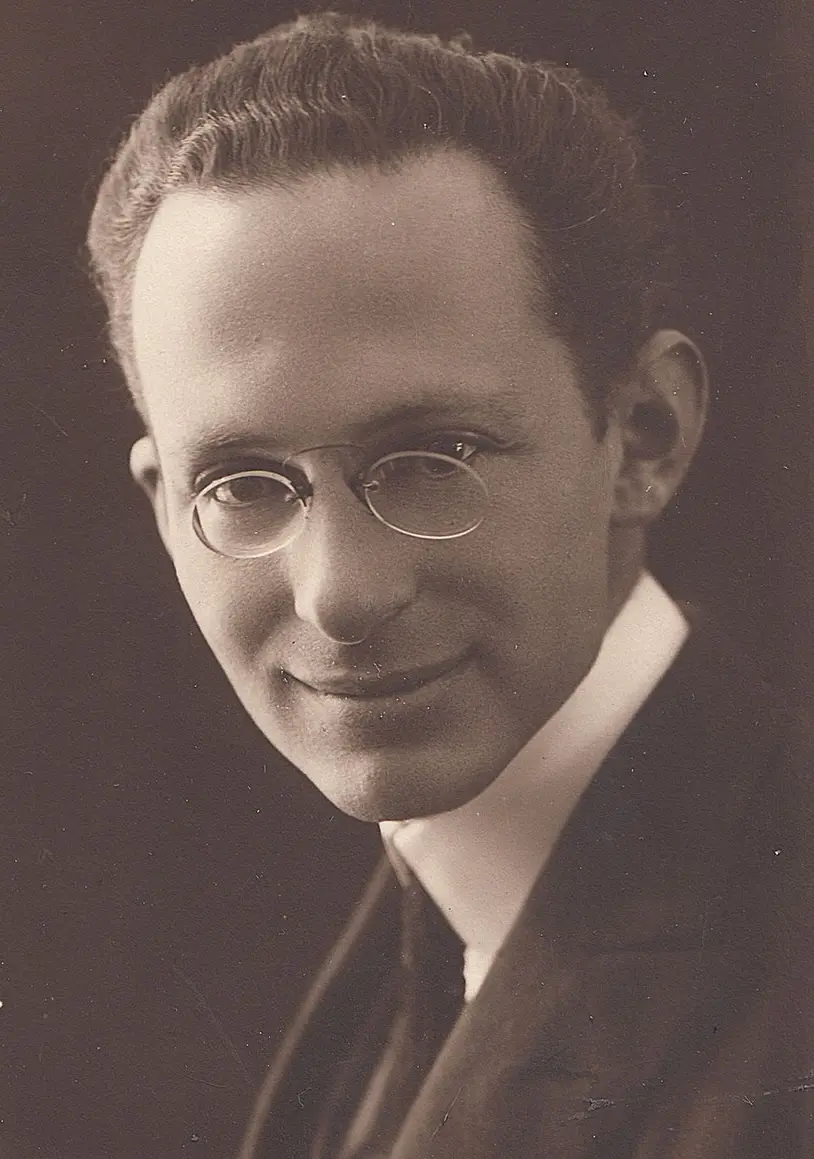
The Composer Who Left Italy and Taught Hollywood to Score
Mario Castelnuovo-Tedesco was born in Florence on April 3, 1895, into a Tuscan banking family. He died in Beverly Hills on March 16, 1968. Almost everything interesting about the second half of that life follows from a single year.
1938
The suppression came before the law did. In 1938, months before Italy’s Racial Laws were formally promulgated, Castelnuovo-Tedesco found himself banned from Italian radio and his performances canceled; a scheduled broadcast of his Second Violin Concerto was dropped without explanation. He was one of Italy’s most performed living composers, and he was Jewish, and the machinery moved ahead of the statute.
He left in 1939 and landed in New York on July 27. Arturo Toscanini helped with the sponsorship and sent his own assistant to meet the family at the dock; he later helped arrange the composer’s American debut with the New York Philharmonic. It was Jascha Heifetz, though, who arranged the thing that determined where the family actually lived: a contract with MGM, in 1940, which took them to Los Angeles.
 Sixteen years of film music
He worked in the studios from roughly 1940 to 1956 and contributed to some two hundred films, a great deal of it uncredited and much of it as collaborator or arranger rather than as the named composer. This is the part of his career that is both most visible and most anonymous.
The lasting effect was not the scores. It was the teaching. He taught composition privately and at Los Angeles City College, and the list of people who studied with him is the reason his name keeps surfacing in film-music histories: Jerry Goldsmith, André Previn, John Williams, Henry Mancini, and Nelson Riddle, who studied arranging and conducting with him from 1947.
An Italian composer driven out of Europe taught a generation of Americans how to write for the screen. We return to that in February.
The guitar, and a meeting in Venice
In 1932, at the International Society for Contemporary Music festival in Venice, Castelnuovo-Tedesco met Andrés Segovia. The meeting produced dozens of works, many of them dedicated to Segovia, and it is the reason a composer with no particular history on the instrument became one of the central figures in its twentieth-century repertoire.
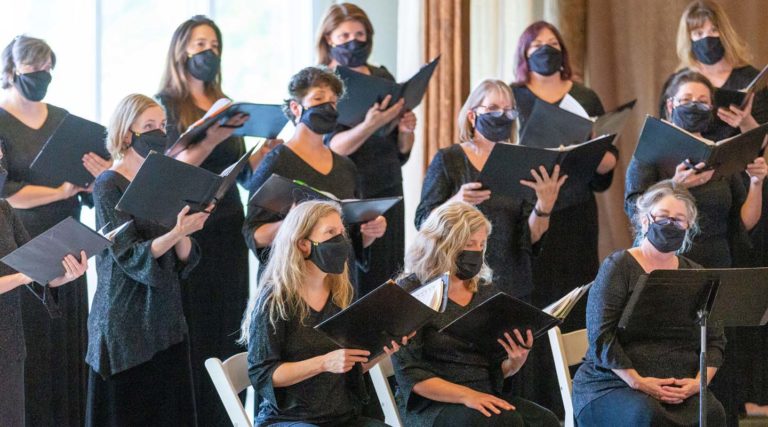
Romancero Gitano, Op. 152, followed in 1951: seven movements for choir and guitar, on poems by Federico García Lorca. It is generally regarded as the first work written specifically for that combination. Before it, the repertoire Nicolò Spera describes wanting to expand did not exist to be expanded.
It was premiered in Berlin by the guitarist Siegfried Behrend with the RIAS chorus, and published by Bote & Bock in 1961 incorporating Behrend’s editorial revisions — which is why the ITER Research Ensemble went back to the original sources and produced a new critical edition in 2024.
 What the pairing does
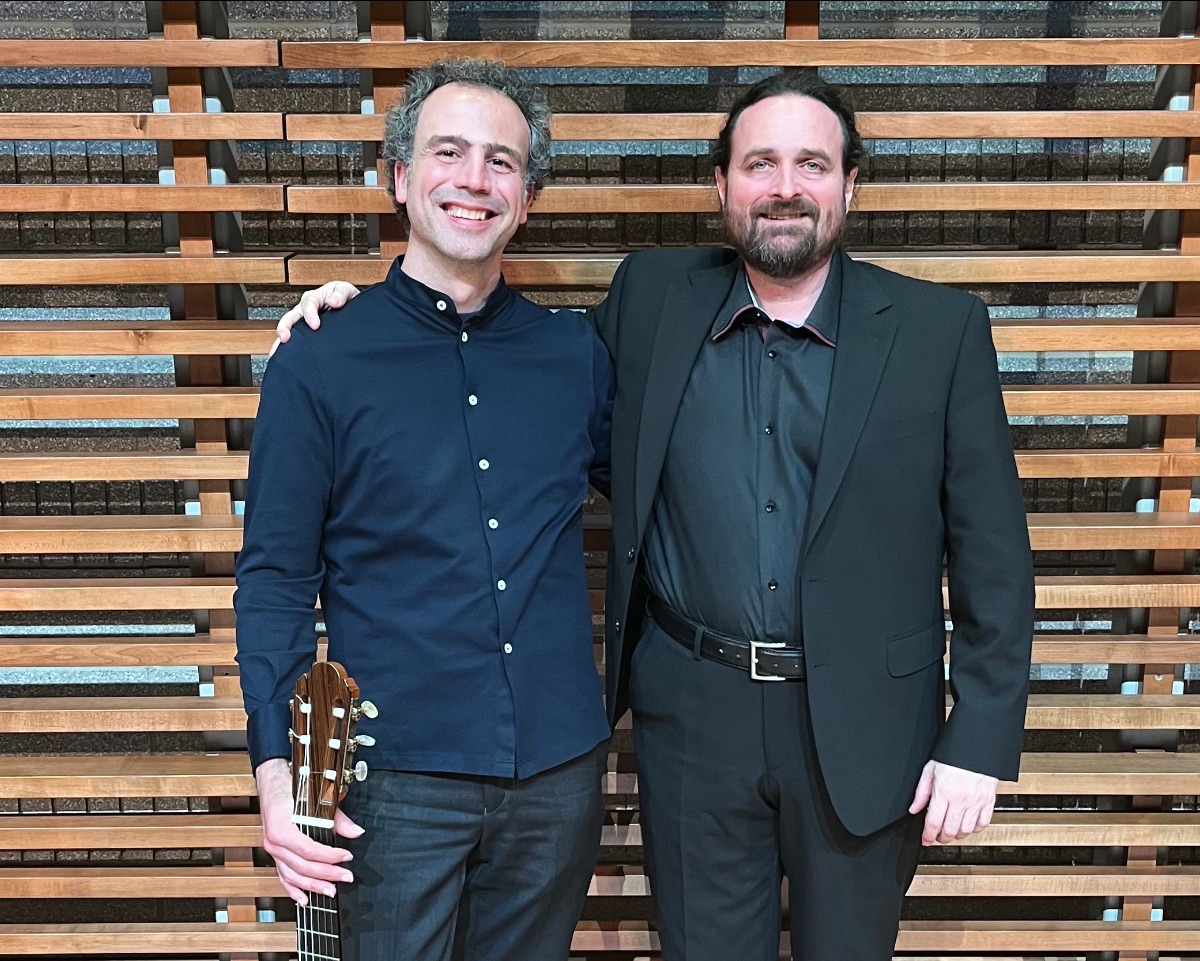
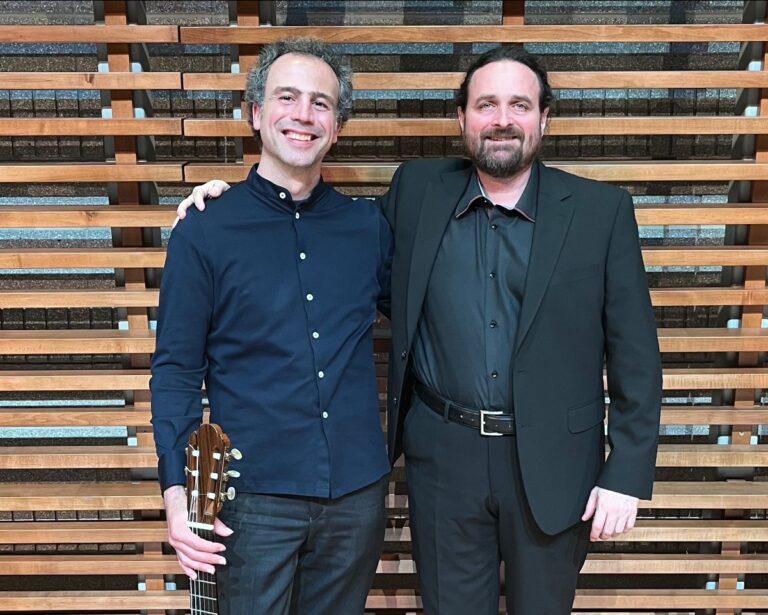
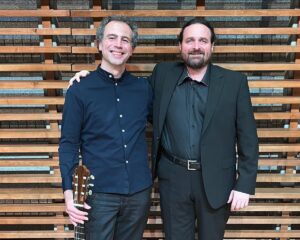
Romancero Gitano was written in Los Angeles by a man who had left Italy because of who he was, on the poems of a man shot in Spain in 1936 for a comparable reason. Seventy years later Corrado Margutti wrote a companion piece about migration and asked it to stand beside this one. Nobody on the program planned that symmetry. It was already there. Margutti’s Rivers was commissioned by guitarist Nicolò Spera.
The performances
Friday, October 9, 7:30 pm, Mountain View United Methodist Church, 355 Ponca Place, Boulder. Saturday, October 10, 7:30 pm, St. Paul Center for Music and the Arts, 1600 Grant Street, Denver, and by livestream. Sunday, October 11, 4:00 pm, United Church of Christ, 1500 9th Avenue, Longmont.
Tickets and details: Rivers & Streams. See also the two works that quote each other and why Nicolò Spera commissioned a piece about immigration.