Why Nicolò Spera Commissioned a Piece About Immigration
By Jonathan Raabe
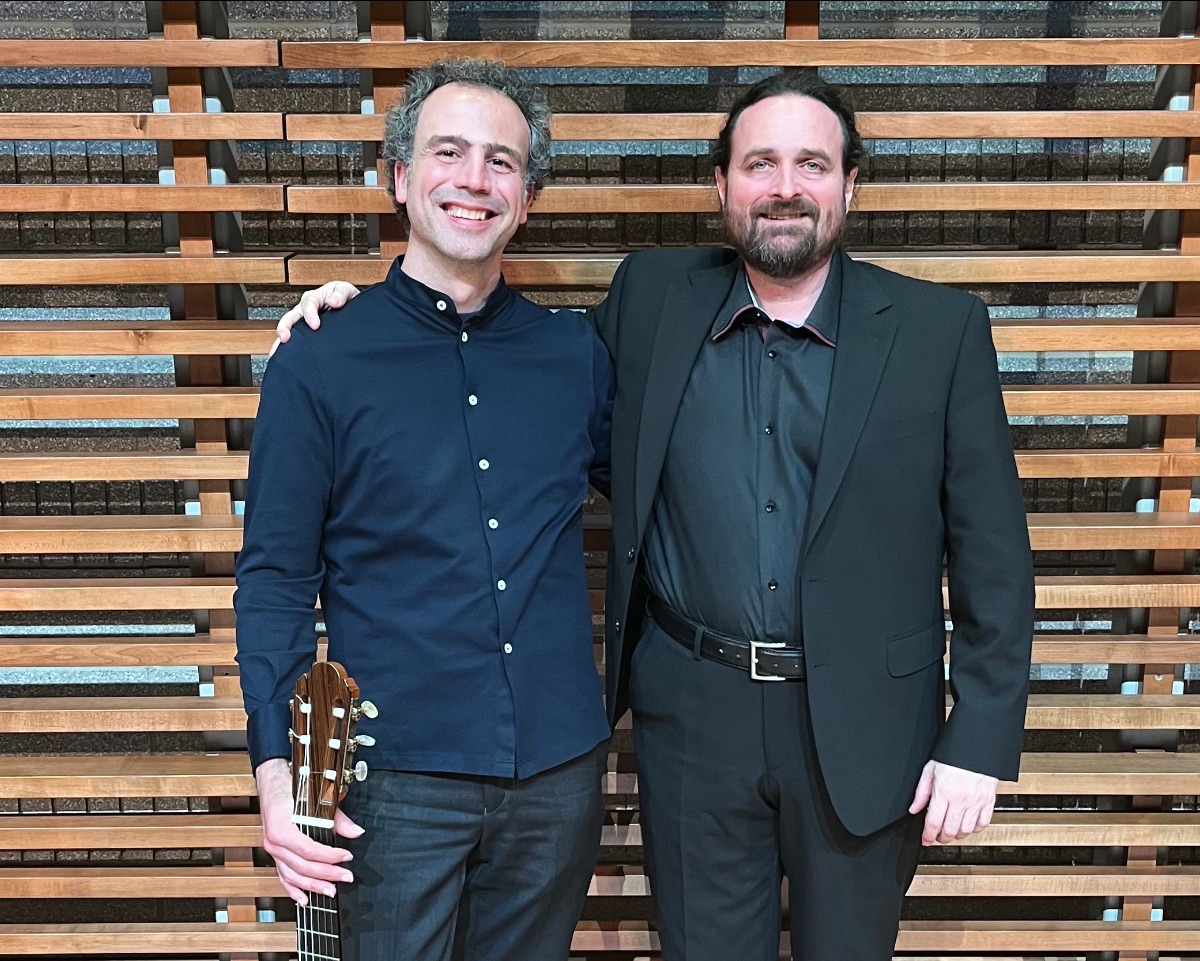
There is a practical reason Rivers exists, and Nicolò Spera gives it plainly: there was only one piece.
“I had played with Ars Nova, the Castelnuovo-Tedesco Romancero Gitano, and it used to be the only piece you will ever play with a choir, and I love choirs, I love choral music, and I was kind of sad that there was one piece. How many times you can play always that piece?”
So he started commissioning. The first was Materna, by Nicola Campogrande, written to mark the birth of his daughter Julia. Rivers, by Corrado Margutti, came later, and it came with a subject attached.
Choosing a composer who knows choirs from the inside
Spera was specific about why Margutti. Writing well for guitar is one skill; writing well for forty voices is another, and the two do not reliably travel together.
“I realized it was important in commissioning a choral piece with guitar to ask someone who actually knew how to write for choir, not just guitar, because not every composer knows how to write well for choir. I decided to ask Corrado Margutti, who is a great singer and choral conductor. And he’s been living in choir since he was five years old, so he really knows how to write well for a choir.”
Margutti is an Italian composer, tenor, and choral conductor. Rivers, Op. 104, is dated 2020, and it is the largest work written for choir and guitar to date — seven movements and a Prologue.
The commission had a subject
Spera did not ask for a piece about water. He asked for a piece about immigration, and he said why:
“I asked him to write a piece about immigration, because I have been very angry and upset by current attitudes toward immigrants.”
What Margutti did with that brief is the reason the piece works. He did not write a protest piece.
“Instead of making it too obvious, he spoke about this idea I gave in a very subtle and poetic way, which maybe is more effective. He just thought, rivers, the idea of rivers, why rivers? Because there are many rivers, but they all go to one sea.”
How the structure carries the argument
The seven movements are in different languages and in different musical styles, and that is deliberate rather than decorative. Spera describes the design:
“Each movement comes from a different place, each movement has a different identity, but they work all together and create this piece, and that’s the idea of humanity we would like our children to live in and work for, a humanity where all the rivers come together to be brothers and sisters, because we are all humans and we all live in the same world.”
The libretto is assembled the same way. Margutti drew on poets from several countries and several centuries, and the cycle ends on “Cordero de Dios” — the Agnus Dei, the last song of the Ordinary of the Mass, in Spanish.
Martino Anibaldi and Diego Franciosi of the ITER Research Ensemble, in their program note for the work, describe the figure traveling through the seven movements as “the suspended and precarious one of the emigrant.”
A note on commissioning
One thing in Spera’s account is easy to pass over. Commissioning a choral work often means commissioning words as well as music.
“Because I came to guitar late in life, and much of my high school education was in classics, I’ve always been drawn to words before music, so poetry, writing, it’s always been something I love. And commissioning choral music often means being able to also commission a libretto, and so working with poets.”
That is how a guitarist ends up responsible for which poets a choir sings. For Rivers, Spera made exactly one non-negotiable request, and it was about a poet rather than a note. We have written about that separately.
The performances
Friday, October 9, 7:30 pm, Mountain View United Methodist Church, 355 Ponca Place, Boulder. Saturday, October 10, 7:30 pm, St. Paul Center for Music and the Arts, 1600 Grant Street, Denver, and by livestream. Sunday, October 11, 4:00 pm, United Church of Christ, 1500 9th Avenue, Longmont.
Tickets and full details are on the Rivers & Streams page. The full conversation with Nicolò Spera is here, and the two works on the program are introduced here.