Posted December 3, 2025
by Kimberly Brody
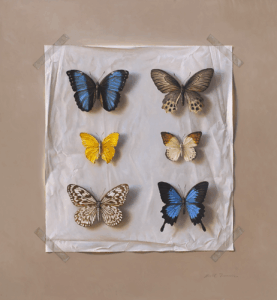
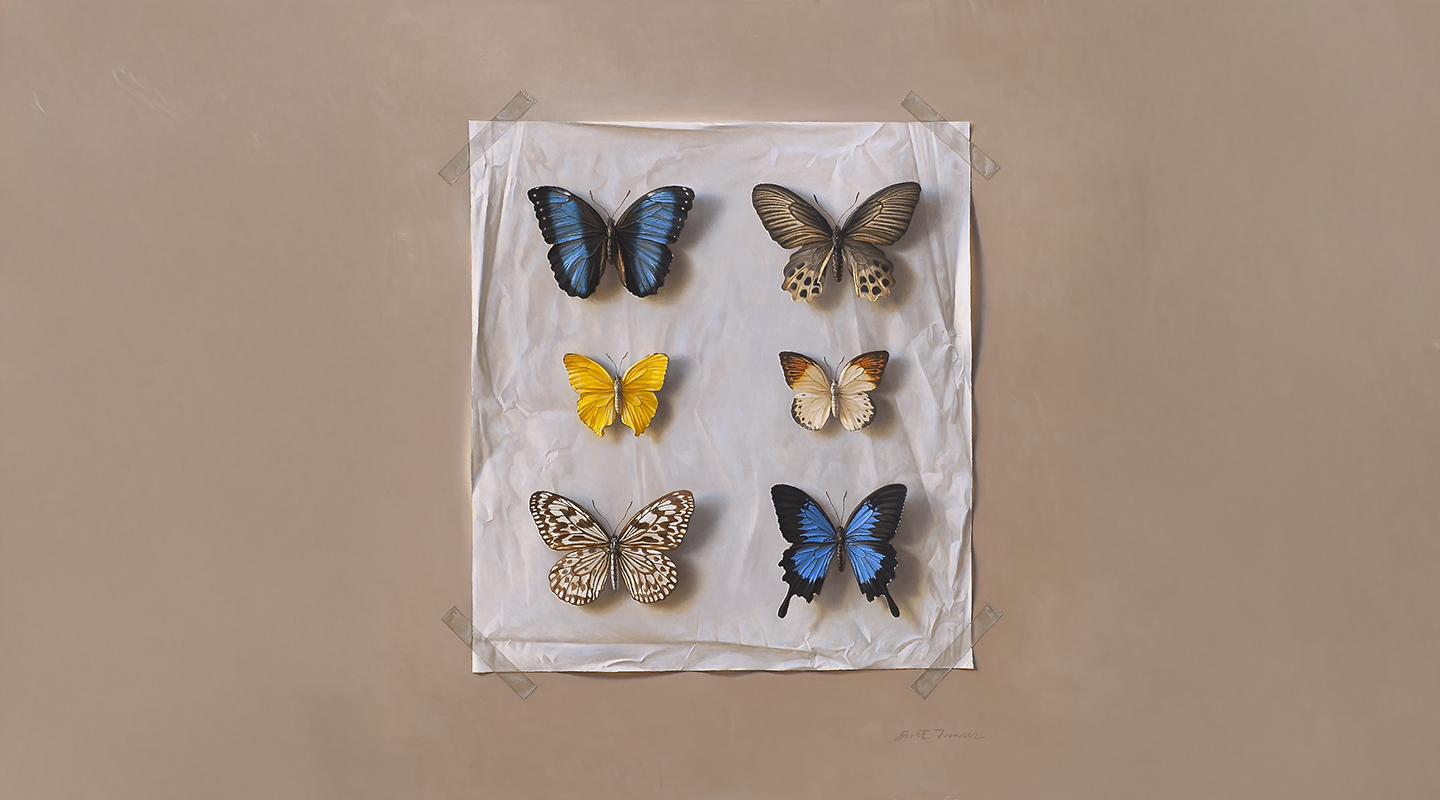
I had the wonderful opportunity to catch up with our season artist, Scott Fraser, and learn more about his creative process. I hope you enjoy this article, and that it will inspire you to bid on our Sweepstakes for the opportunity to own one of Scott’s works – a “Six Butterflies” print!
According to Scott, the print that is available in our Sweepstakes is an “Artist’s Proof,” or AP, which is a print from a limited edition reserved for the artist, marked with “AP” or “A/P” instead of a number in the main edition. Historically, APs were used to check print quality, but they are now often sold separately, and their rarity can make them more valuable to collectors than the numbered prints in the edition.

Kimberly Brody: Have you been and artist your whole life? Do you recall the first painting you ever made? What was it?
Scott Fraser: My earliest memory is of doing a painting of roses when I was three. It is framed and hanging in my studio. I grew up in the Chicago area and when my parents saw my interest in art, we made frequent trips to the Chicago Art Institute, helping to cement my dream of being an artist from a very early age.
KB: How has your style evolved over the years?
SF: Making things appear real is something I have always gravitated towards. I went to the Kansas City Art Institute and the teachers there wanted students to understand a variety of styles and approaches, spanning from historical works to present day, including abstraction and surrealism. I developed a broader understanding of many different approaches to creativity, which has definitely carried over into my own work. I have a great appreciation for many different approaches to making art.
KB: Can you briefly describe your process from start to finish? How long does a painting take to complete?
SF: I paint from life. I have a large studio with really good north light, which helps. Once I have assembled or constructed an idea, I will do a very thorough drawing, then transfer it to my gessoed panel. Then I begin with very transparent underpainting and work over that with a wet into wet oil phase, stacking color with as little blending as possible to maximize luminosity.
KB: You have been described as “quirky.” Do you agree?

SF: As a still life painter, I prefer not to be too conservative with my subject matter. I don’t shy away from less traditional imagery, since I think it makes for much more memorable imagery. I lean heavily on objects that resonate with me personally – my mother-in-law’s silver spoons, rocks and shells collected on vacations or hikes, objects gifted to me by friends. I have an open mind and no shortage of subject matter, which is perhaps why my work might seem quirky.
KB: How do you come up with your ideas?
SF: I am always scribbling ideas on post-its and tacking them to my studio wall. They will evolve or be discarded and I actually get some of my ideas when I am sleeping. My daughter has an excellent sense of composition and I have painted some of her ideas just as she set them up. My wife’s musical background has provided some great subject matter too. I have many more concepts than I know what to do with.
KB: How many paintings do you create each year? Are they mostly commissioned?
SF: That is variable. My work is labor intensive, and if I am working on a large project, my output might be as few as 12 pieces in a year. I guess I usually average around 20. This allows each of the 6 galleries I work with to have a few new ones through the year to sell. I rarely do commissions.
KB: You’ve mentioned William Harnett as an inspiration. How did you develop your own personal style? Are there other painters who have inspired you?

SF: It has been an evolution. When I was in art school I started out as a print maker, then I worked in egg tempera, then graduated on to oil after I left KCAI. I was painting landscapes before spending a year in Europe, where my study of the old masters led me to gravitate to still life. I have been focusing on that ever since. I am inspired by so many artists, it’s hard to know where to start. I have an extensive collection of art books that I am constantly referring to, from the Dutch Masters to the Impressionists to Abstract Expressionism.
KB: Are there other painters that you mentor, or who credit you as their inspiration?
SF: I don’t teach, so I can’t answer to mentoring in that kind of traditional way. I have had a number of artists come to my studio to paint with me and ask questions or seek advice. I am always happy to share what I can. It’s a tough business and a traditional art education leaves lots of gaps when it comes to making it as a fine artist. I try to help them make informed decisions about their process and career directions.
KB: What is the most well-known place that your work is shown?
SF: I have paintings and drawings in a number of museum collections, including the Metropolitan Museum of Art, but that painting has yet to be included in a show there. This is not uncommon for living artists to not get their work on the wall since their collection is so vast.
My painting, Three Fishermen, was on display at the Denver Art Museum for 25 years. It came down when they remodeled recently, and I don’t know if it is back on the wall or not. I like it when someone tells me they saw my work on display at other museums.
KB: Where in Colorado can people see your work?
SF: I show at Gallery 1261 in Denver, at Vail International Gallery in Vail and at Raven Gallery in Aspen.
This is the “Six Butterflies” print that is offered in our Sweepstakes. The online portion of the Sweepstakes ends on December 4, (click here for online entries through 10:00 pm on December 4), but if you attend our holiday concerts in person, you’ll have the opportunity to see the actual framed print and place your bid at any one of the four performances. The drawing takes place on December 15.